

Listen to the blog
Once an organization has decided to implement HubSpot, many people are eager to start using the tools: for example, to build automated email and task sequences for sales, create workflows, adding downloadable guides and forms to the website, and creating personalized experiences for website visitors. However, rushing isn’t worth it. Implementing HubSpot should always start with aligning HubSpot with your organization’s business strategy and getting the big picture right.
So what does “the big picture” mean when it comes to implementing HubSpot? Rather than starting with technical details or individual tasks, you should take a top-down approach.
Simply put, this means that HubSpot is put to work right from the start to support business goals and strategy. We create a clear vision of what we’re doing and what our objectives are. Everything we do in HubSpot supports these mutually agreed-upon, measurable goals.
Schedule a time with a HubSpot expert on the calendar
A unified view of the goals for using HubSpot
HubSpot is a digital tool, and like any tool, it doesn’t produce results on its own. Instead, you need to know how to use it correctly and in a strategic way.
Using it correctly doesn’t just mean knowing how to perform technical tasks in the HubSpot portal; it means aligning HubSpot with your business goals. At its best, HubSpot is a strategic tool. If it’s used solely as a tactical tool, its potential will inevitably remain unrealized.
It’s also important when using HubSpot to ensure that the entire organization recognizes its benefits. For example, all salespeople should know how and why HubSpot is used within the organization. This helps ensure they are committed to using it in their work as agreed. If employees are unclear about why they should use HubSpot, they’ll easily view it as just an extra burden and won’t use it actively.
Painting the big picture helps give everyone a consistent understanding of why HubSpot is used.

Getting a Return on Investment
If a HubSpot project skips the step of defining the big picture, the entire project usually ends up going off track and falling apart. In the end, no one knows what the purpose of the project was or what goals HubSpot is supposed to serve within the company. The budget spirals out of control, and decisions are made by a show of hands when different people or departments want different things. The technology—HubSpot—becomes disconnected from the rest of the business, and different parties use it in different ways. HubSpot is used only because management has ordered it to be used, for example, as a CRM or a marketing automation tool, but no one knows why it’s being used or what the objectives are.
HubSpot is always an investment for a company, so it should be made to deliver results. However, this doesn’t happen automatically just by implementing HubSpot. If the use of HubSpot isn’t aligned with the organization’s strategy, the HubSpot portal won’t deliver the desired added value to the company, and a large portion of the investment will go to waste.
Employees may also conclude that HubSpot is a useless tool and even stop using it. This could lead to a situation where, for example, some salespeople actively use HubSpot while others do not use it at all. In that case, HubSpot fails to serve its purpose, as the data it generates will inevitably be of poor quality.
Creating the big picture keeps HubSpot’s development efforts on track. Based on this, a roadmap is created to help ensure the right things are done in the right order.
Listen to the Kasvupodcast episode “The Big Picture – Roadmap” below -->>
A Roadmap for Implementing HubSpot
A roadmap is part of creating the big picture: what steps need to be taken to reach your goals? It’s a strategic plan that defines your goals, the key steps needed to achieve them, and the milestones along the way.
It ensures that HubSpot is integrated into the organization’s business operations in a measurable way.
The elements covered when creating a roadmap are, in principle, simple. However, to achieve them, you need the right people at the table—that is, the company’s decision-makers and a HubSpot expert who knows how to actually use HubSpot to help the company reach its goals.
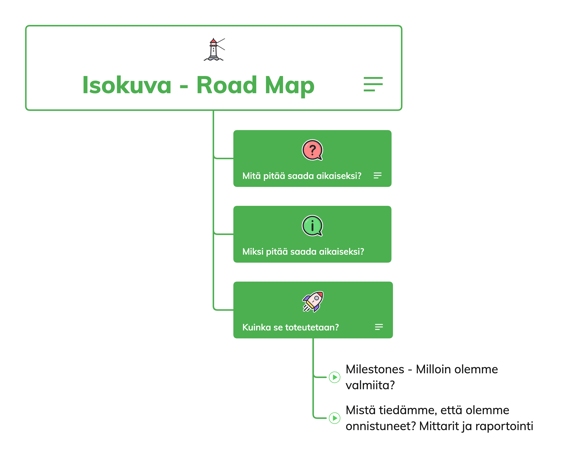
The key questions when creating a roadmap are:
- What do we want to accomplish?
- Why do we need to achieve it?
- How will it be implemented?
- When will the goal be achieved?
- How will we know if we’ve succeeded—in other words, how will success be measured?
SMART Goals
By creating a big-picture view, the organization has a plan for what needs to be done to achieve its business goals using HubSpot. Everyone is also moving in the same direction—toward the same goals. For example, sales and marketing have a unified vision of what they need to achieve and how to get there.
When talking about goals, it’s easy to think of something vague, such as wanting to automate the company’s sales and marketing and save on human resources.
When discussing HubSpot goals, we’re always talking about what are known as SMART goals. SMART stands for specific, measurable, achievable, relevant, and time-bound. In other words, the goals are specific, measurable, achievable, relevant, and time-bound.
Automating work can therefore be a good goal, but it must be expressed in a measurable way, and a deadline must be set for the goal. The goal must also be achievable: for example, expecting a single salesperson to do the work of ten salespeople in the future is probably not a very realistic goal.
When setting goals, we also consider the steps needed to achieve them. For example, what needs to be accomplished by the next quarter, and where will we be a year from now?
By defining these goals, HubSpot can be truly integrated into the business. Everyone understands how and by when the goals are to be achieved, as well as how success will be measured.
Who needs to be involved in planning the big picture and the roadmap?
When creating the big picture for a HubSpot project, it’s important to involve the company’s top leadership, even if they don’t use HubSpot themselves in their day-to-day work. Exactly who should be involved depends on the organization and its specific needs for using HubSpot.
Senior management’s involvement is key because the goal is to align HubSpot with the company’s strategy and objectives—in other words, with the company’s own big picture. Senior management has the best understanding of the company’s strategy and is ultimately responsible for the company’s results.
If senior management isn’t committed to the project, the agreed-upon plans may not align with the company’s strategy and direction. This creates uncertainty throughout the organization, or tasks are handled differently, and different users have conflicting agendas. Different departments may form their own, conflicting views on the goals of using HubSpot. This will derail the entire project.
Sometimes it makes sense to reboot HubSpot
A HubSpot project doesn’t always mean that HubSpot is a new tool for the organization. Often, HubSpot has been implemented without first carefully considering the purposes it is intended to serve, and its use has not been aligned with the company’s strategy in any way.
In many cases, HubSpot has been in use for a long time but no longer serves the original purpose for which it was implemented. Often, the HubSpot portal has remained in the same state it was in when it was first implemented. Business is constantly evolving: its goals change and become more specific, and entirely new goals emerge. The same should apply to HubSpot. The portal must evolve alongside the business, whether that involves growth, international expansion, or acquisitions.
The HubSpot relaunch is led by an expert HubSpot partner, who—ideally—will continue to provide ongoing support after the relaunch project to ensure effective use of HubSpot and that the set goals are achieved.
How can you tell if a HubSpot project has been successful?
So how do you know if you’ve successfully integrated HubSpot into your business strategy? At its simplest, it’s when numerical—or measurable—goals have been achieved within the set timeframe. The data tells the story—it shows, without mercy, whether results have been achieved. These metrics can include, for example, revenue, advertising effectiveness, or work efficiency, that is, whether HubSpot has been successfully leveraged to reduce the time staff spends on repetitive, manual tasks.
How can we ensure that the use of HubSpot continues to align with our strategy?
Simply creating a big-picture view isn’t enough; you must continue to ensure that HubSpot usage remains aligned with business objectives. Necessary adjustments to usage must be made whenever the business changes.
The best way to do this is to conduct a quarterly review of the HubSpot portal. During this review, we assess whether we’ve completed the agreed-upon tasks and made progress toward our goals, or whether the goals have changed. At the same time, we assess whether the portal needs to be modified or refined, or if there is a need to implement new tools.
In our HubSpot projects, we always keep the big picture in mind
In Sales Communications’ HubSpot implementations and HubSpot relaunches, we always examine the big picture: that is, what the business objectives are and how HubSpot aligns with them. This ensures that our clients get the most out of their HubSpot investment and that the tools become a seamless part of their business operations.